
Journal
Buggy Board for iCandy Pushchair: Best Fit 2026
Ellie Marsh · · 7 min read
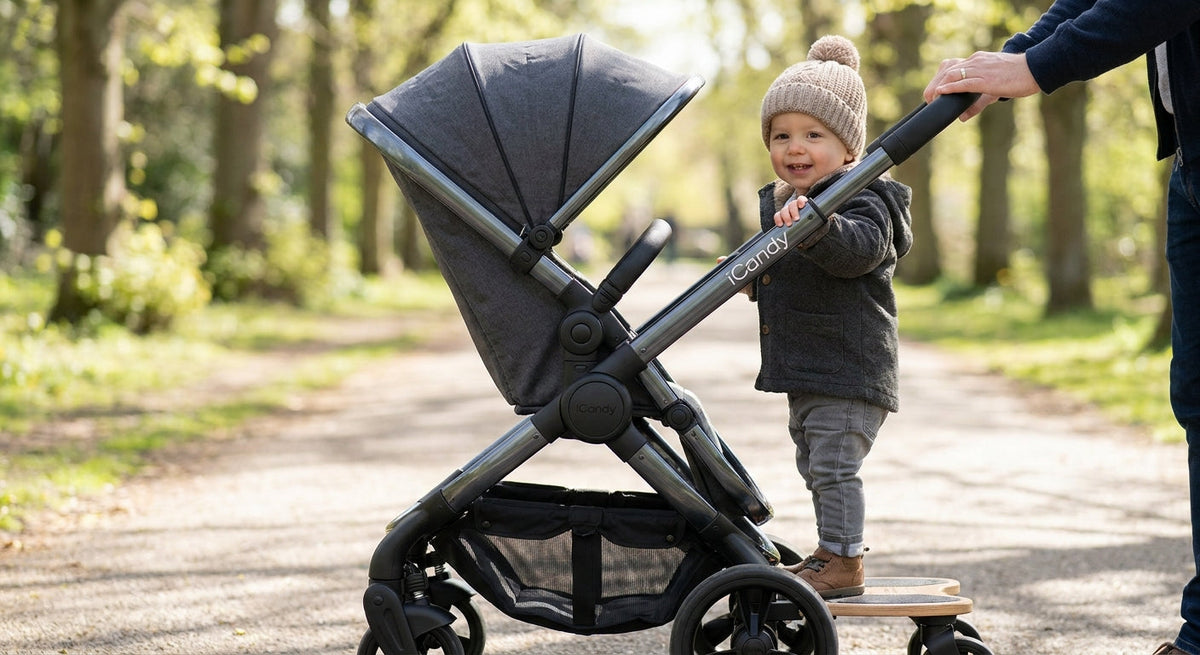
An iCandy pushchair has a distinctive low, wide chassis, and that geometry is exactly why so many buggy boards clip on crooked, scrape the rear wheels, or wobble at the first kerb. This guide breaks down what actually fits Peach, Orange, and Core frames in 2026, and what to skip.
- A buggy board for iCandy pushchair needs a connector matched to the rear axle, not a generic universal clamp.
- iCandy Peach 8, Orange 4, and Core2 chassis differ enough that a board fitted for one can wobble badly on another.
- Stand-only boards suit toddlers under three; seated saddle boards work better once a child hits four or five.
- Boards without a stabiliser strap are the main cause of wobble complaints on iCandy's low-slung tube frame.
- Message The Tiny Traders before you buy and we can help you check a buggy board will fit your actual iCandy chassis.
Why this matters
A buggy board that doesn't match your iCandy chassis isn't a minor annoyance, it's a stability risk on a moving pushchair with a baby in the seat unit above it. The rear axle spacing on an iCandy pushchair sits closer to the frame than on many budget three-wheelers, and that narrower gap is where most fitting problems start.
Get the connector wrong and you'll feel it within the first fifty metres: a board that rocks side to side every time your toddler shifts their weight. Get it right and the board becomes invisible, the pushchair steers the same as it did before you added it.
Who this is for
This is for parents already running an iCandy travel system, Peach, Orange, Core, or an older Peach 6/7, with a toddler who's outgrown the pram but still tires out on the school run or a supermarket trip. It's also for families expecting a second baby who want the older sibling riding alongside the new pram seat instead of walking the whole route. If you haven't bought your iCandy yet and are still comparing chassis, the buggy board question is worth factoring into that decision now rather than retrofitting later.
What to look for in a buggy board for iCandy pushchair
Chassis connector type
Most boards use either a clamp-style bracket or a slide-in bar that hooks under the rear axle. iCandy's frame tubing sits lower than most competitors, so a bracket designed for a taller chassis often grips at the wrong angle and leaves the board tilted backward. Check the fitting diagram against your specific iCandy model before ordering, Peach and Core frames are not interchangeable in this respect.
Wheel and axle clearance
The rear wheels on an iCandy Orange or Core sit close enough to the frame that a wide board footprint can rub tyre against plastic on tight turns. A board with a narrower deck, or one with an offset mount, avoids the scrape. This is the single most common return reason cited for buggy boards bought without checking the specific chassis first.
Weight and age rating
Most stand-on boards carry a rider up to roughly 20kg, which covers most children until around age four or five depending on build. Beyond that weight, the added load changes how the whole pushchair balances, particularly with a baby also in the seat unit. Match the rating to your child's actual weight now, not their age on paper.
Stabiliser strap or anti-wobble bar
A strap that runs from the board's mounting point to a second point higher on the frame cuts side-to-side wobble dramatically on iCandy's tube chassis. Boards without this extra point of contact rely purely on the axle clamp, which flexes more than parents expect once a toddler starts bouncing on it. If the listing doesn't mention a stabiliser point, assume it doesn't have one.
Fold compatibility
Can you fold your iCandy one-handed with the board still attached, or does it need removing first? Some boards fold flat against the chassis and travel with the pushchair; others have to come off entirely before you collapse the frame, which is a dealbreaker if you're folding and lifting a pram into a car boot solo every day.
Ride mode: stand or seated
A stand-only board suits toddlers who want to hop on and off quickly at the school gate. A board with a fold-down saddle seat suits a child who tires mid-walk and needs somewhere to sit without you unclipping the whole unit. Decide which matches your actual daily routine rather than buying the more expensive option by default.


Top picks by iCandy chassis
iCandy Peach 8, the wide-track match. The Peach family runs a wider rear track than Orange or Core, which gives most standard boards more clearance before the wheel rub becomes a problem. The Tiny Traders stocks the iCandy Peach 8 Editions Collection bundle in coffee bean, and this chassis is the easiest of the three families to fit a stand-on board to without a rub or a wobble complaint. Buy if you're starting fresh and buggy board compatibility is a priority.
iCandy Orange 4 and Core2, the narrower squeeze. Both chassis sit closer at the rear axle than Peach, at £1,249 for the Orange 4 Latte and £1,329.70 for the Core2 in black. A board still fits, but you need one with a narrower deck or an offset mount to avoid tyre scrape on tight pavement turns. Consider these frames if you already own one; check the deck width before buying rather than assuming a universal label covers it.
Generic universal clip-on boards with no iCandy-specific fitting notes, the risky guess. Plenty of budget boards market themselves as fitting most pushchairs without naming iCandy specifically. On a low, wide iCandy tube frame that's exactly where wobble complaints originate, and the fix in most cases comes down to how you fit the connector, worth reading how to fit a buggy board without it wobbling before you buy rather than after. Skip unless the listing explicitly confirms iCandy compatibility.
What to avoid
- Boards with only a single clamp point. Without a second stabiliser contact, every bump on uneven pavement transfers straight into the pushchair's steering, see best buggy boards for uneven pavements for the pavement-specific version of this problem.
- Boards rated well above your child's actual weight. A 25kg-rated board sounds like headroom, but an overbuilt board is often heavier itself, which adds drag to the whole pushchair and makes it harder to push one-handed.
- Boards that require full removal to fold the pushchair. If you fold your iCandy daily to fit it in a car boot, a board you have to unclip every single time turns a five-second fold into a two-minute job.
Verdict comparison
| Chassis family | Rear track width | Fit difficulty | Verdict |
|---|---|---|---|
| iCandy Peach 8 | Wide | Low | Buy |
| iCandy Orange 4 | Narrower | Medium | Consider |
| iCandy Core2 | Narrower | Medium | Consider |
| Generic universal board (any chassis) | Unconfirmed | High | Skip without fitting confirmation |
FAQ
What's the best buggy board for an iCandy pushchair?
A board with a stabiliser strap and a connector confirmed for your specific iCandy model, Peach, Orange, or Core, fits best in 2026. Generic universal boards are more likely to wobble on iCandy's low, wide tube chassis.
Do all iCandy pushchairs take the same buggy board?
No. The Peach family has a wider rear track than Orange 4 or Core2, so a board that fits one chassis without rubbing can scrape the wheel on another. Check the deck width against your specific model before buying.
How much does a buggy board cost in 2026?
Prices vary widely by brand and features like a fold-down seat or stabiliser strap. Compare the fitting notes for your iCandy model first, since a cheaper board that doesn't fit properly ends up costing more in returns.
Is a seated buggy board better than a stand-on board?
A seated board suits a child who tires mid-walk and needs to sit without being unclipped from the pushchair. A stand-on board suits a toddler who wants to hop on and off quickly, such as at a school gate.
Why does my buggy board wobble on my iCandy pushchair?
Wobble on an iCandy chassis almost always comes down to a single clamp point with no stabiliser strap. Adding a second contact point higher on the frame, or switching to a board designed with one built in, fixes most cases.
What weight can a buggy board hold?
Most stand-on boards carry a rider up to roughly 20kg, which covers most children until around age four or five depending on build. Match the rating to your child's actual weight rather than their age.
Can I fit a buggy board to an iCandy Peach 8?
Yes, the Peach 8's wider rear track gives most standard boards more clearance than the Orange 4 or Core2 chassis. It's the easiest of the three current iCandy families to fit a stand-on board to without a rub or wobble.
Do I need to remove the buggy board to fold my pushchair?
It depends on the board. Some fold flat against the chassis and travel with the pushchair; others require full removal before the frame collapses, which matters if you fold your iCandy daily for the car boot.
One last thing
The fitting problem people report most often isn't the board itself, it's skipping the test-fit step entirely and ordering from a photo. The wheel-rub issue that online reviews rarely mention is worth checking before you order, so message The Tiny Traders with your iCandy model and we will help you check the connector fits.


